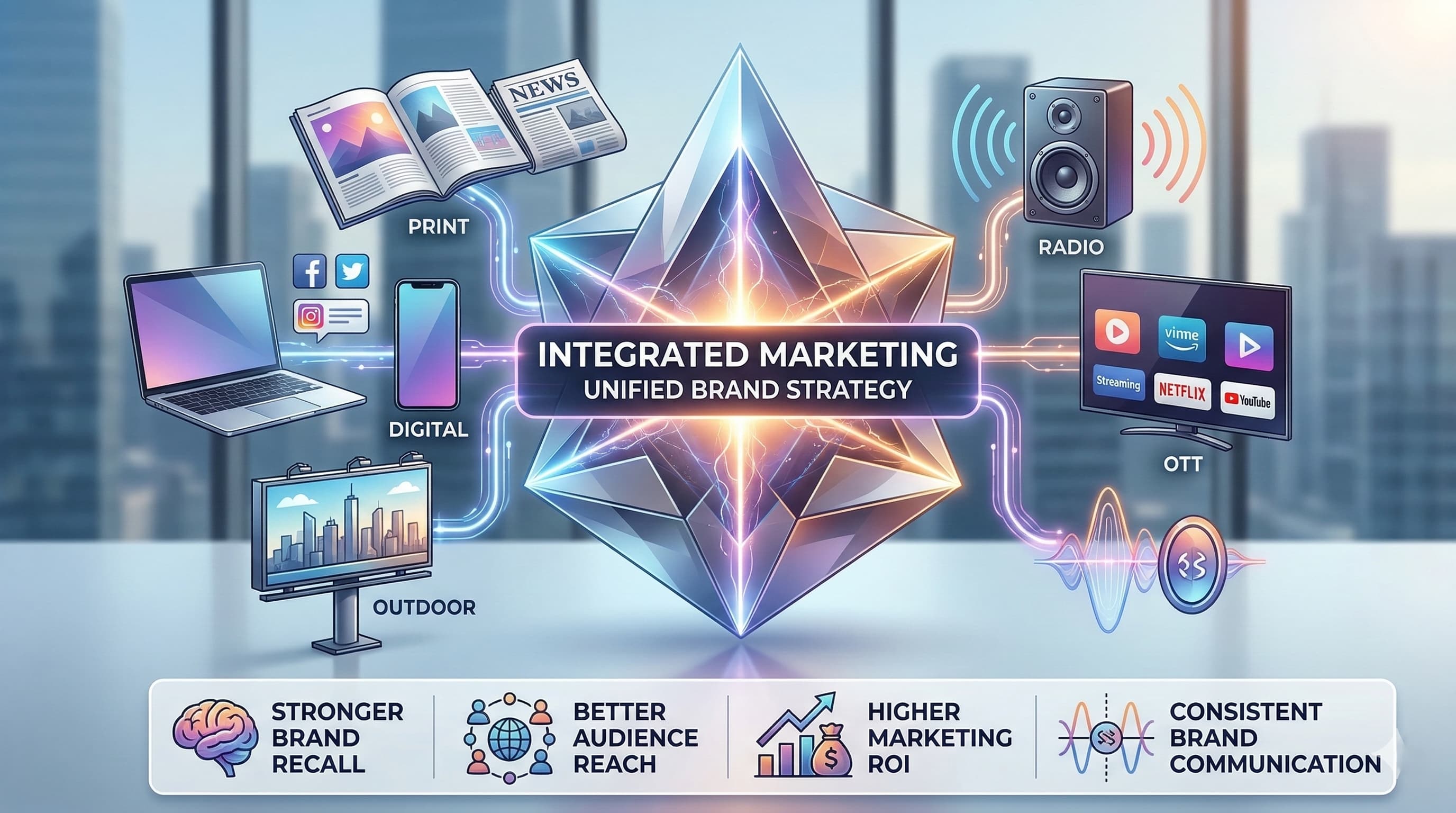
In today's competitive market, brands cannot rely on a single advertising channel to reach customers. Consumers interact with brands across multiple platforms — search engines, social media, outdoor billboards, television, and radio. This is where integrated marketing becomes essential.
An integrated marketing strategy ensures that all marketing channels work together to deliver a consistent brand message and maximize impact. Businesses that adopt full spectrum marketing build stronger brand recall, reach wider audiences, and achieve better marketing ROI.
What is Integrated Marketing?
Integrated marketing is a strategy that combines multiple advertising channels — including digital, print, radio, OTT platforms, and outdoor advertising — to create a unified brand experience.
Instead of running isolated campaigns, integrated marketing connects all communication channels so that the audience receives the same brand message across platforms.
For example, a brand might run:
- Google and social media ads for lead generation
- Outdoor hoardings for brand visibility
- Radio or OTT ads for wider audience reach
- Print ads for credibility and trust
This approach is also known as omnichannel advertising in India, where multiple platforms work together to reinforce the brand message.
The Problem with Fragmented Marketing Campaigns
Many businesses run separate campaigns across digital and traditional media without coordination. This fragmented approach often leads to:
- Inconsistent brand messaging
- Reduced brand recall
- Lower campaign effectiveness
- Wasted advertising budgets
When marketing channels operate independently, the audience experiences disconnected brand communication. Integrated marketing solves this problem by ensuring every platform contributes to the same marketing objective.
Key Benefits of Full Spectrum Marketing
1. Stronger Brand Recall
When audiences see your brand across multiple platforms — digital ads, hoardings, radio, and OTT — it strengthens brand recognition and credibility.
2. Better Audience Reach
A full spectrum marketing approach ensures brands reach both online and offline audiences, maximizing visibility.
3. Higher Marketing ROI
An effective integrated marketing strategy improves campaign efficiency because each channel supports the others.
4. Consistent Brand Communication
Integrated campaigns maintain a unified brand voice across all marketing channels, building trust with customers.
How a 360 Degree Marketing Agency Helps
Executing an integrated marketing campaign requires expertise across multiple advertising platforms. This is where a 360 degree marketing agency plays a crucial role.
A professional agency manages:
- Media planning and buying
- Digital advertising campaigns
- Outdoor and print media placements
- Radio and OTT advertising
- Campaign performance tracking
By aligning all marketing channels under a single strategy, businesses achieve stronger brand positioning and improved campaign performance.
Integrated Marketing in India: The Future of Advertising
With increasing media consumption across digital and traditional platforms, omnichannel advertising in India is becoming the standard approach for modern brands. Businesses that combine digital marketing with outdoor, print, radio, and OTT advertising gain a competitive advantage in building both awareness and conversions.
Conclusion
Integrated marketing is no longer optional for brands aiming to scale. A well-planned integrated marketing strategy combines digital and traditional media to create a unified brand experience. Businesses that adopt full spectrum marketing benefit from stronger brand recall, wider reach, and better return on advertising investment.
Partnering with a 360 degree marketing agency ensures that every marketing channel works together seamlessly, helping brands turn ideas into effective execution.
Topics